Furniture and home6 min read
Outdoor furniture AR: terraces, weather and a very short selling season
Placing garden furniture on a real terrace, why outdoor AR is harder than indoor, and how to use 3D against a season that lasts weeks.
By CharpstAR · 4 Oct 2023 · Updated 22 Sept 2026
Part of Augmented reality for furniture retail: the complete guide
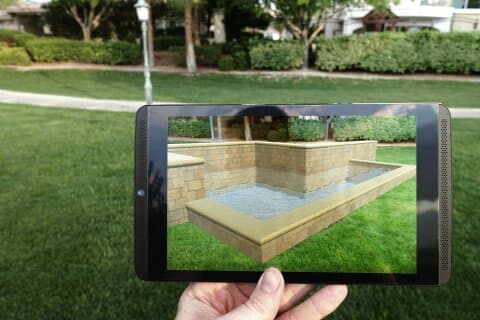
Outdoor furniture has a harder commercial shape than indoor furniture. The season is short, the buying decision happens in a burst after the first warm weekend, the products are large and expensive to return, and the customer is buying something that has to survive weather they cannot predict. Augmented reality helps with some of that and not with the rest, and outdoor AR has technical quirks that indoor AR does not.
Why terraces are a good AR case
The core question for garden furniture is the same as for indoor furniture, only sharper. Will this fit, and will it leave room to walk around.
Terraces, balconies and decks are usually smaller than the living rooms people compare them to, and they are irregular. A balcony has a railing, a door that swings outward, a drain, a corner that is not square. A six-seat dining set that fits the floor area on paper often does not fit the actual space once you can open the door.
AR settles this better than it settles most indoor questions, because outdoor spaces are frequently empty. There is no existing furniture for the virtual model to be wrongly rendered in front of, the ground is a large flat plane the phone reads instantly, and the shopper can walk right around the placed model without bumping into anything. Occlusion, which is the thing that makes multi-object indoor AR look wrong, mostly does not arise.
The other reason it is a good case: the shopper is often standing on the terrace already, in spring, thinking about it. That is a better moment than any product page interaction indoors.
The three things that are harder outdoors
Bright sunlight. Phone AR estimates ambient lighting and renders the model to match. In direct midday sun the estimate is less stable, the phone screen is hard to see, and the model can look washed out or oddly lit. Nothing you can do about the physics, but it is worth knowing that the best outdoor AR sessions happen on overcast days and in the evening, and that a shopper trying it in glare may come away unimpressed with your product rather than with the conditions.
Uneven ground. Decking with a slope, a lawn, gravel. Plane detection assumes flat and will place a table that appears to hover at one corner. On grass it is worse, because the phone struggles to lock a plane onto a soft, uniform, moving surface. Paved terraces and decking work well. Lawns are unreliable.
No reference objects. Indoors, the shopper judges a virtual sofa against a real sofa they already own. Outdoors there is often nothing to compare against, which makes correct scale even more important and makes dimension annotations on the model genuinely useful rather than decorative.
Weather and materials, which is what the 3D model should be arguing
The second question every outdoor buyer has, after fit, is whether the thing will survive winter. This is a materials question, and it is the one your product page usually answers badly with a line of specification text.
A 3D model is a good place to answer it because the shopper can get close to the material and because hotspots can carry the explanation where they are already looking. Powder-coated aluminium against untreated teak against synthetic rattan is a decision about weathering, maintenance and how the thing will look in year three, and it deserves more than a dropdown.
Things worth building into the model or the page around it:
- Material at close range. Teak grain, the weave of all-weather rattan, the texture of powder coat. These read very differently up close and the difference is what justifies the price gap between ranges.
- How it ages. Teak silvers. Say so, and show it, because customers who were not told treat it as a defect.
- Cushion and cover behaviour. Whether cushions are left out, what the fabric is rated for, whether a cover is included.
- Storage and stacking. Whether it folds, stacks or has to live somewhere all winter. This is a dimensional question and the model can answer it.
Working with a season that lasts weeks
The commercial problem with outdoor furniture is that demand arrives suddenly and leaves suddenly. A 3D catalogue helps with that in ways that have nothing to do with the AR button.
Imagery before stock. Renders come out of the same model as the viewer. New range photography can exist before the containers land, which means the product is live and sellable on day one of the season rather than three weeks in.
Campaign imagery without a shoot. Outdoor lifestyle photography needs good weather, which is exactly what you do not have when you are shooting next year's range in November. Rendered scenes do not care about the forecast.
Variant coverage. Frame colours and cushion fabrics multiply fast in this category. One model with a material library covers all of them at close to zero marginal cost per variant.
| Season stage | What the 3D asset does |
|---|---|
| Pre-season, no stock yet | Renders for the site, catalogue and email before product arrives |
| First warm weekend | AR placement on the terrace, at the moment of peak intent |
| Mid-season | Variant and configuration choices handled self-service |
| Out of season | Same assets carry the pre-order and clearance campaigns |
That first row is often the real return on the investment in this category, and it has nothing to do with augmented reality at all.
The evidence, honestly
There is no published, checkable dataset specific to outdoor furniture AR. What exists is general and points one way. Shopify reported in 2020 that products with 3D or AR content converted 94 percent more often than comparable products without. Its published merchant results include a 65 percent purchase lift on AR-enabled pages at Rebecca Minkoff and a 5 percent return reduction at Gunner Kennels. The NRF and Appriss Retail put the online return rate at 17.6 percent of sales in 2023, which for large outdoor items is an expensive percentage.
The technical side is settled: Android's Scene Viewer handles GLB models on ARCore devices running Android 7.0 or later, and Apple's AR Quick Look handles USDZ in Safari from iOS 12 onwards. There is nothing for the customer to install, which matters more than usual in a category where the session happens outdoors on a phone.
Start before the season, not during it
The mistake we see most in this category is commissioning models in April. Modelling takes time, the first product takes the longest while the material library gets built, and by the time it is live the selling window is half gone. Commission in autumn, launch in February.
Start with one product. We will build it for free and you keep it whether or not you continue. Send us your bestselling set with dimensions and material close-ups. You can see how the same approach works for indoor ranges in our work with Sweef and MELIMELI, the full service is on the solutions page, and the monthly cost per product is on the prices page.
Sources
- Google, Scene Viewer documentation.
- Apple, AR Quick Look.
- Shopify, merchant data on 3D and AR content, September 2020.
- Shopify, AR shopping: Rebecca Minkoff and Gunner Kennels results.
- National Retail Federation and Appriss Retail, 2023 Consumer Returns in the Retail Industry.