3D for e-commerce5 min read
Augmented reality and trust: accuracy, real scale and honest product information
AR builds trust only when the model is accurate. What true scale, honest materials and visible dimensions do for buyer confidence, and how a bad model fails.
By CharpstAR · 4 Oct 2023 · Updated 22 Sept 2026
Part of Augmented reality for furniture retail: the complete guide

Trust in online shopping is mostly a question of whether the product page told the truth. Did it arrive the size you expected, in the colour you expected, made of what the description said. Everything a retailer does to build trust, reviews, return policies, photography standards, is an attempt to close the gap between what the page promises and what turns up.
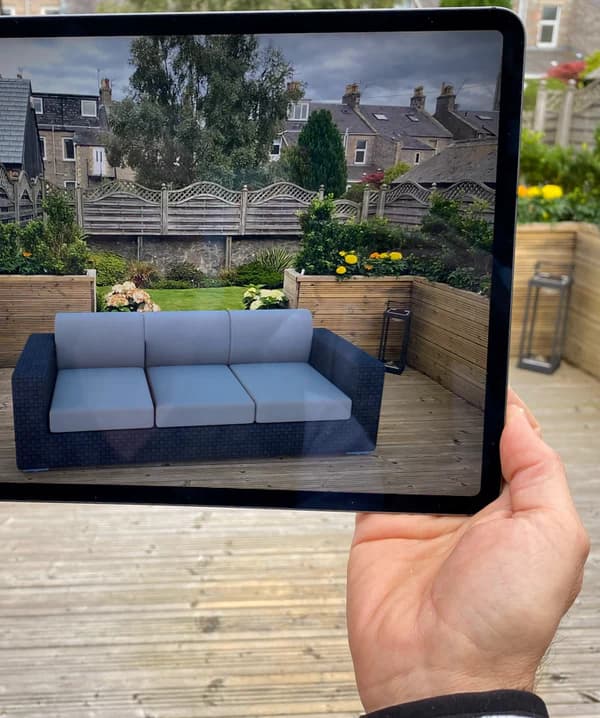
Augmented reality can close a chunk of that gap, because it shows the product at true size in the buyer's own space. It can also widen the gap badly, because a confident, interactive, wrong model is more misleading than a photograph. Which of those you get depends entirely on accuracy, and accuracy is a production decision, not a technology one.
The trust gap AR can close
Three specific promises are hard to keep with photographs.
Size. A photograph has no scale. A sofa in a styled room looks like whatever the room implies, and shoppers consistently misjudge. AR removes the guess: the phone knows the floor and the walls, the model appears at its real dimensions, and the buyer sees whether it fits between the window and the door.
Proportion and back views. Photography shows the angles that flatter. A 3D model shows all of them, including the back, the underside and the join the photographer avoided. The willingness to show every angle is itself a trust signal, and shoppers read it that way.
Material. Zoom into a well-made model and you see the actual weave, the grain direction, the way a metal takes light. Zoom into a cheap one and you see a repeating tile. Shoppers zoom into materials more than anything else, which makes this the place where an honest model earns its keep.
Why accuracy is the whole argument
An AR view carries more authority than a photo. The shopper sees it in their own room, through their own camera, and treats it as evidence rather than marketing. That authority is borrowed from reality, and if the model is wrong the retailer has spent it on a false claim.
A model that is five percent too small is the worst case, because nothing about it looks wrong. The buyer places it, decides it fits, orders it, and discovers the truth on delivery day. That is a returned item, a refund, a delivery cost, and a customer who now distrusts every interactive feature on your site. A visibly bad model damages a page. An invisibly inaccurate one damages the brand.
So the trust question reduces to a production question. Were real dimensions used, or were they estimated from photographs. Were the material samples measured, or approximated. Was the model checked against the physical product by someone who has seen it. These are the things to ask a supplier, and the answers separate the vendors.
What honest product information looks like
| Signal | What the shopper gets | Why it builds trust |
|---|---|---|
| Dimensions drawn on the model | Size read off the product, in their units | Removes the most common cause of a bad surprise |
| Every angle available | Back, underside, joins, cable routes | Shows you are not hiding anything |
| Material zoom | Real weave and grain rather than a flat colour | The detail a photograph flattens |
| Annotations on features | What a part is made of, how it opens, what is included | Answers the question at the point of doubt |
| Variant accuracy | The colour shown is the colour shipped | A wrong swatch is a broken promise |
| AR at true scale | The product in their actual room | Converts a guess into a check |
Notice that none of these are AR features exactly. They are information-quality features that an accurate 3D model makes possible, and AR is one of the ways they get delivered.
What happens when you get it right
The measurable effect shows up in returns before it shows up anywhere else. Gunner Kennels, in Shopify's case-study write-up, reduced return rates by 5 percent after adding 3D and AR. That is the shape of the result to expect: a modest, durable reduction driven by fewer surprises rather than a dramatic conversion jump.
The scale of the opportunity is why it matters. The National Retail Federation and Appriss Retail put United States retail returns at 743 billion dollars in 2023, 14.5 percent of sales, with online purchases returned at 17.6 percent against 10.02 percent in store. That online gap is, in large part, the gap between what a page promised and what arrived.
The conversion evidence exists too and deserves a caveat. Shopify reported in September 2020 that interactions with products carrying 3D or AR content converted 94 percent more often than comparable products without, and Rebecca Minkoff saw shoppers 44 percent more likely to add to cart after a 3D view and 65 percent more likely to purchase after AR. Those compare shoppers who chose to interact with those who did not, so part of the gap is pre-existing intent.
Where we see it work
Contura sells wood-burning stoves, which most people buy once in their lives and have no reference point for. Placing the stove at real size in the actual room, before an order, replaces a conversation full of uncertainty with a check the buyer makes themselves. Sweef does the equivalent for modular sofas, where the configuration question is genuinely difficult to answer any other way. MELIMELI uses the fabric picker so the material shown on screen is the material in the model, rather than a photograph shot under different lighting.
In each case the trust benefit comes from the same source: the page stopped approximating.
What to do if you want this
Start with the products where a size or material surprise costs you the most, which is usually the same list as your highest return rates. Insist on real measurements in the brief. Put the viewer in the main image gallery rather than below the buy button, add dimension lines and annotations, and check the model against the physical product before it goes live.
Then watch return rate and support contacts, not just conversion. Trust shows up as fewer problems rather than as more clicks.
Our own plans include dimensions, annotations and yearly updates so the model stays true to the product as it changes, with details on the prices page and the range of what we build on the solutions page. If you want to judge the accuracy for yourself, send us one product and we will model it for free and hand it back, yours to keep whatever you decide: free sample. Measure it against the real thing with a tape. That is the right test.
Sources
- National Retail Federation and Appriss Retail, 2023 Consumer Returns in the Retail Industry.
- Shopify, AR shopping: Rebecca Minkoff and Gunner Kennels results, and 3D ecommerce guide.
- Shopify, merchant data on 3D and AR content, September 2020.