3D for e-commerce6 min read
Selling made to order without stock: what a 3D configurator actually replaces
How furniture brands sell made-to-order with a configurator instead of a showroom and a warehouse, what it replaces, and what it does not.
By CharpstAR · 4 Oct 2023 · Updated 22 Sept 2026

A furniture brand that offers a sofa in six modules and twenty fabrics has, on paper, a catalogue of thousands of products. Nobody builds thousands of sofas and puts them in a warehouse. They build to order. The problem has never been manufacturing, it has been selling: a shopper cannot see what they are ordering, so the brand either photographs a few combinations and hopes, or it rents a showroom and staffs it.
A 3D configurator is the piece that removes that trade-off. Every combination exists as a model instead of as stock or as a floor sample. That is a real change to what a brand has to own, and it is worth being exact about which costs it touches and which it leaves alone.
What stock actually gets carried, and why
There are three separate reasons a made-to-order brand ends up holding physical product:
| Reason | What it costs | Does 3D remove it |
|---|---|---|
| Display samples in a showroom or dealer floor | One unit per variant shown, plus the floor space and the staff | Mostly, if the shopper can configure and place the product themselves |
| Photography samples for the website | One unit per variant shot, plus studio time per shot | Yes, once the model exists, renders come from the same asset |
| Buffer stock for fast delivery | Warehouse space and capital tied up in guesses about demand | No. That is a promise about lead time, not a visualisation problem |
The third row is the one vendors skip over. A configurator does not shorten your production lead time. If your customers expect a sofa in four days, you will still hold stock. What changes is that you hold it because you chose a delivery promise, not because you needed something for a customer to look at.
The MELIMELI and Sweef pattern
Both brands sell sofas that exist mainly as combinations. MELIMELI sold in a way that depended on the in-store experience: fabrics you could touch, a sofa you could sit on, a salesperson who could tell you which modules fit a seven-square-metre living room. The digital version of that had to do three jobs at once, which is why the build is a 3D viewer for the sofa, a fabric browser, and AR placement in the customer's own room rather than any one of the three on its own.
Sweef came at it from the other side. They already had internal 3D resources for a modular range and needed them turned into something a customer could operate. The result is a configurator where the modules are assembled by the shopper and the finished arrangement can be placed at real size in their room.
The shape of both projects is the same. One well-built model of the parts, plus the rules for how they combine, replaces a photographic catalogue that would have needed a physical unit per combination. That is the inventory argument, and it is sound for display and photography. It is not an argument about your warehouse.

Finish
Log store
Floor plate
A made-to-order stove as a shopper sees it. Sixteen combinations out of one model, and not one of them had to be built, stocked or photographed.
What AR adds on top of the configurator
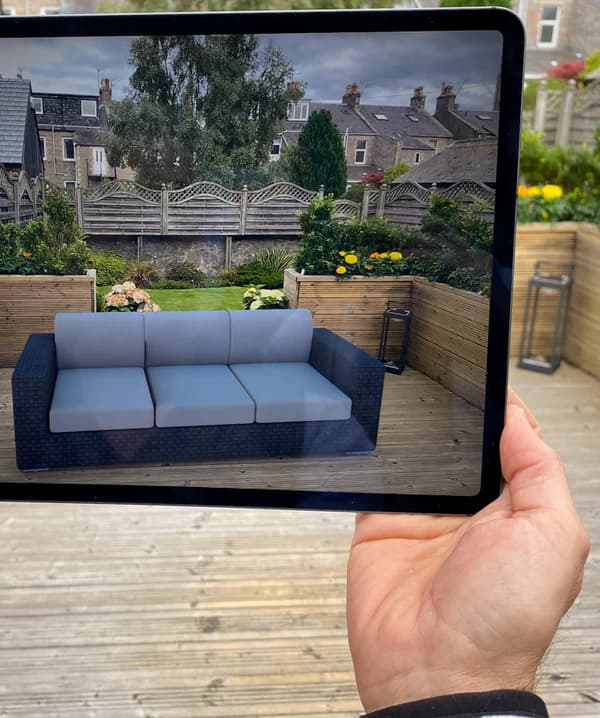
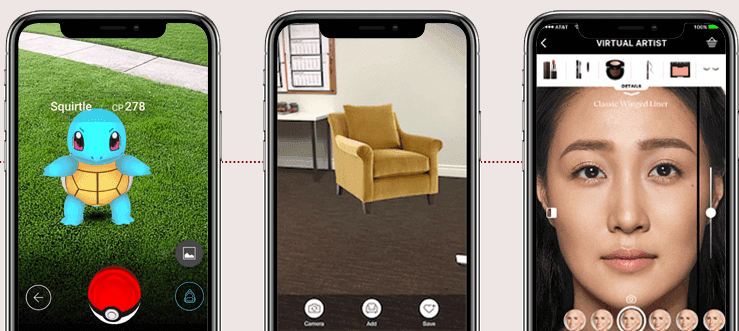
Configuring is the first half. The question the shopper still has is whether the thing fits. Web AR answers that by putting the configured model into the camera view at true scale, using Scene Viewer on Android and Quick Look on iOS. No app, no download, a button on the product page.
For a made-to-order brand this is the part that replaces the showroom visit most directly. The reason people go to a furniture shop is rarely to admire the fabric. It is to work out whether a three-metre corner sofa will swallow their room. A correctly scaled model in that room settles it, and it settles it at eleven at night when the shop is closed.
What the numbers support, and what they do not
Shopify reported in 2020 that interactions with products carrying 3D or AR content converted 94 percent more often than the same kind of products without. In their own write-ups, Rebecca Minkoff found shoppers who viewed a product in AR were 65 percent more likely to buy, and shoppers who saw a 3D model were 44 percent more likely to add it to cart. Those are merchant-reported results from a platform with an interest in the answer, and they measure conversion, not inventory.
There is no published figure that says a configurator lets you hold X percent less stock, because that number depends entirely on how a given brand was operating before. What you can calculate for yourself is straightforward: count the physical units you currently own purely so that someone can look at them, whether on a showroom floor or in a photo studio queue, and price them. That is the number a configurator goes after.
What tends to break
Three things, consistently.
Rules that do not match the factory. A configurator that lets a shopper build a combination you cannot manufacture creates orders your production team has to phone customers about. The combination logic has to come from the people who build the product, not from the catalogue.
Lead times that arrive too late in the flow. Made to order means waiting. If the shopper finds out at the checkout that their fabric adds five weeks, you have spent the whole configurator experience setting up a disappointment. Put the lead time next to the choice that causes it.
Materials that flatter. A fabric that renders richer than it looks in daylight buys you a sale and a return. Material accuracy is dull work and it is the work that decides whether the tool reduces returns or increases them.
What it costs to run
Our pricing is per product per month rather than a one-off build fee, because models need maintaining as ranges change. Basic starts at 10 dollars per product per month on a twelve-month term with a minimum of 100 variants, which suits a brand turning a large catalogue into models. Value starts at 20 dollars per model per month on a twenty-four-month term for products that need more detail and configuration. Enterprise is quoted against the range.
Set that against a showroom lease, or against the cost of shooting a variant catalogue every time the fabric book changes, and the comparison is usually not close for a made-to-order brand.
Where to start
Do not model the catalogue. Model the product that generates the most pre-purchase questions, which for most furniture brands is the largest modular item, and see whether the questions stop. We will build one product as a 3D model and put it on your page so you can measure it yourself. Send us one product and it is yours to keep.
Sources
- National Retail Federation and Appriss Retail, 2023 Consumer Returns in the Retail Industry.
- Shopify, merchant data on 3D and AR content, September 2020.
- Shopify, AR shopping: Rebecca Minkoff and Gunner Kennels results and 3D e-commerce.
- Google, Scene Viewer developer documentation.
- Apple, AR Quick Look.