Automotive5 min read
Augmented reality in automotive retail: configurators, showroom AR and what it changes
How AR and 3D configurators are used to sell cars rather than drive them: what dealers deploy, what the evidence says, and what the asset work involves.
By CharpstAR · 4 Oct 2023 · Updated 22 Sept 2026

Most writing about AR and cars is about heads-up displays: navigation arrows painted on the windscreen, hazard highlighting, lane guidance. That is real engineering and it belongs to the vehicle, not to the retailer. This article is about the other half, the part that happens before anyone owns the car. Configurators, showroom AR, and putting a vehicle in a customer's driveway through a phone.
That half matters commercially because a car is the clearest case of a product nobody can stock in every variant. A dealership might hold a dozen cars. The configurator holds every trim, every wheel, every paint code, every interior, and the customer specifies against it. AR is what happens when that configuration leaves the screen and appears at real size.
The three things dealers and OEMs actually deploy
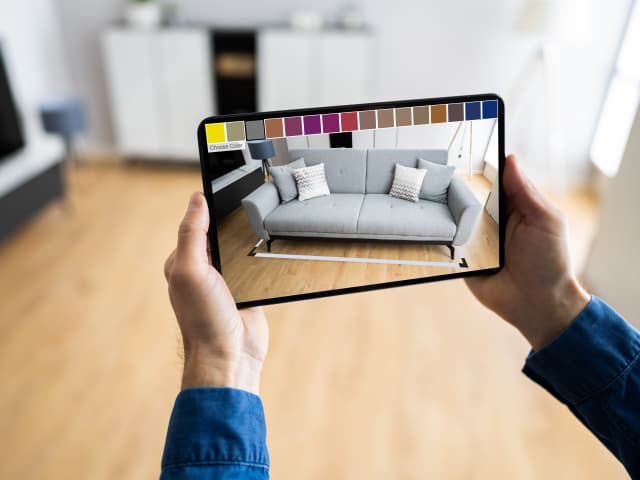
The online configurator. A 3D model of the car, rendered live in the browser, that updates as the customer changes paint, wheels, trim and interior. This is the workhorse and it has been standard on premium brands for years. Almost every AR feature is a viewer bolted to this same model.
Showroom AR on a large screen or tablet. The customer stands next to a physical car in one specification and sees the others. This is the answer to the floor-space problem: a showroom can display three cars and specify three hundred.
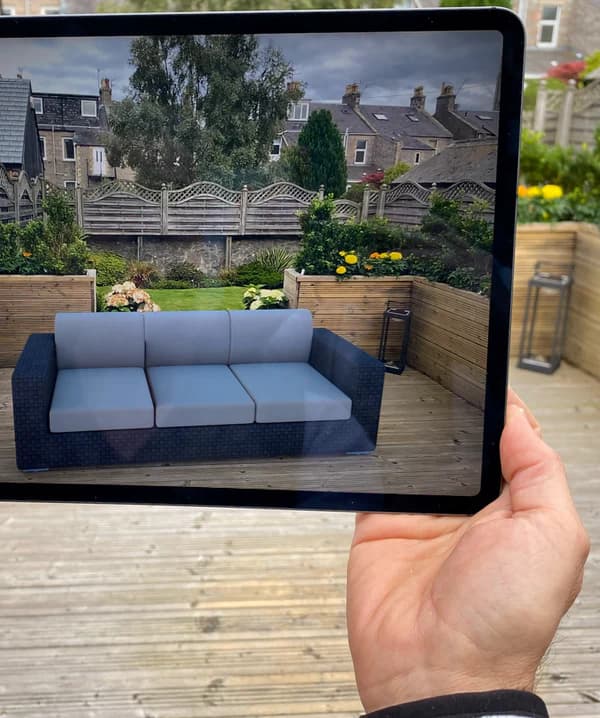
Phone AR placement. The customer points a phone at their own driveway or parking space and the configured car appears at true size. This answers two questions that photographs cannot: does it fit, and does that paint colour look the same outside my house as it did on a screen in an office.
What matters about all three is that they run off one asset. The same model that renders the configurator renders the showroom screen, the phone AR, the brochure imagery and the advertising stills.
What the evidence says
The honest position is that the published evidence for automotive AR is thinner than for general e-commerce, and much of what circulates comes from vendors.
Transforma Insights, reviewing virtual car showrooms, reports 79 percent of dealers believing in-store digital tools make processes more efficient, 86 percent of potential vehicle purchasers believing digital tools save time in showrooms, and dealerships that integrated virtual reality showrooms and augmented reality test drives seeing a 20 percent increase in customer conversions. Those are survey and industry figures rather than audited results, and the first two measure belief rather than behaviour, which is a weaker thing than it sounds.
The broader e-commerce numbers are better established and probably transfer in direction if not in size. Shopify reported in September 2020 that interactions with products carrying 3D or AR content converted 94 percent more often than comparable products without. Rebecca Minkoff, in Shopify's case study, saw shoppers 44 percent more likely to add to cart after viewing in 3D and 65 percent more likely to purchase after AR. Those are shoppers who chose to interact, so intent is baked into the comparison.
A car is not a handbag, and the decisive metric is different. Nobody buys a 40,000 euro vehicle from a phone screen. What the configurator and AR change is the quality of the visit: the customer arrives having already specified, having already ruled out two paint colours and decided on the larger wheels, and the conversation starts further along.
Where AR helps most in a car purchase
| Question | Does AR answer it | Notes |
|---|---|---|
| Will it fit my garage or parking space | Yes, well | True-scale placement is exactly what AR does |
| What does this paint look like in daylight | Partly | Better than a screen swatch, still limited by the camera |
| What is the interior like | Yes, in a 360 viewer | Panoramic interior views are more useful here than AR |
| How does it drive | No | This is what a test drive is for |
| Which trim level is worth it | Yes, indirectly | Side-by-side visual comparison makes the upsell concrete |
| Is the boot big enough for my things | Weakly | Dimension overlays help more than the AR view does |
That table is the reason we would put money into the configurator and the dimensional information before putting it into a headset experience. The questions AR answers well are size, space and appearance questions.
The part nobody budgets for
Car configurators fail on content, not on code. A vehicle range is enormous once you multiply trims by paints by wheels by interiors, and every one of those combinations has to look right. Paint in particular is difficult, because metallic and pearlescent finishes depend on how light moves across the body, and a flat colour swap looks wrong immediately.
Then the range changes. Model years, new colours, discontinued wheels, facelifts. A configurator that is not maintained goes stale within a year and starts showing customers things they cannot order, which is worse than showing nothing.
This is the same problem every large catalogue has, and the answer is the same: treat the 3D asset as a maintained part of the product record, not as a campaign deliverable. Our own model for that is a monthly fee per product that includes yearly updates, so a change to the product is a change to the model rather than a new project. The structure is on the prices page.
What transfers from other categories
We build configurators and web AR for furniture and home products rather than cars, and the mechanics are closer than they look. Sweef has the combinatorial problem, a modular sofa where the customer assembles the configuration. MELIMELI has the finish problem, one shape across many fabrics, solved by switching material on a live model instead of photographing every version. Contura has the placement problem, a stove nobody can picture in their own room until they see it at true size there.
A car retailer has all three at once, at a larger scale. The lesson from the smaller categories is that the configurator is worth more than the AR button, the AR button is worth a lot on the placement question, and both are worth nothing if the underlying models are not accurate.
If you are starting
Pick the single highest-consideration product in your range and model it properly, with true dimensions and real materials. Put it in a viewer on the product page with an AR button and measure enquiry quality for a month. That is a cheap experiment, and for one product it costs nothing at all, because we will build the first model free and you keep it either way. Send us one product, or read what else we build on the solutions page.
Sources
- Transforma Insights, Virtual car showrooms: AR and VR enhancing customer experience.
- Shopify, merchant data on 3D and AR content, September 2020.
- Shopify, AR shopping: Rebecca Minkoff and Gunner Kennels results, and 3D ecommerce guide.