3D for e-commerce5 min read
Should your business use augmented reality? A decision guide, including when not to
Six questions that decide whether AR is worth the money for your products, what to do if you answer no, and how to run a test that gives a real answer.
By CharpstAR · 4 Oct 2023 · Updated 22 Sept 2026
Part of Augmented reality for furniture retail: the complete guide

We build 3D models and web AR for retailers, and we turn down work reasonably often, because for a lot of catalogues the honest answer is that AR will not earn its cost. This is the decision guide we would give someone who asked us over coffee, including the parts that argue against buying anything from us.
Work through six questions. If you answer yes to the first three, the case is probably good. If you answer no to any of the first two, stop.
1. Does your shopper hesitate over size, space or material?
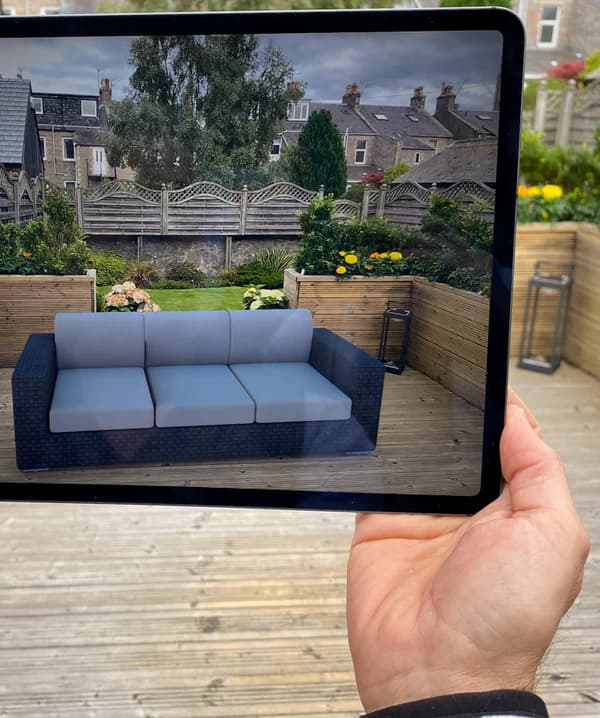
AR answers exactly one question well: what does this object look like at its real size, in my room or on my face. If that question is what stops your shoppers, AR is a direct fix. If their hesitation is about price, specification, delivery time or whether the brand is trustworthy, AR touches none of it.
Sofas, stoves, wardrobes, lighting, bicycles, glasses: yes. Phone cases, socks, supplements, software: no. Most catalogues have a handful of products in the first group and a long tail in the second.
2. Is the object rigid enough to model honestly?
A 3D model has to look like the thing you ship. Hard goods with defined geometry model well. Fabric on a moving body does not, which is why garment try-on remains a styling preview rather than a fitting room. Anything whose appeal is smell, taste, weight or feel is outside what a model can carry.
If your product changes shape in use, be sceptical of anyone promising a faithful AR representation of it.
3. Is the order value high enough?
Run the arithmetic before the demo. Our pricing starts at 10 dollars per product per month on Basic, twelve-month term with a minimum of 100 variants, and from 20 dollars per model per month on Value with a twenty-four month term. At those rates, a product with a 400 euro margin needs a very small conversion or returns effect to pay for itself. A product with a 6 euro margin needs a miracle.
The returns side of the arithmetic is often the stronger half. The National Retail Federation, with Appriss Retail, put US returns at 743 billion dollars in 2023, 14.5 percent of sales, with the online rate at 17.6 percent. Shopify reports Gunner Kennels cut return rates by 5 percent after adding AR. On a high-value item that number alone can justify the project.
4. Is your product page otherwise in good shape?
This is the question that most often produces a "not yet". Baymard's meta-analysis of 50 studies puts average cart abandonment at 70.22 percent, and the leading stated reasons are extra costs at checkout at 40 percent, slow delivery at 20 percent, card-details trust at 19 percent and forced account creation at 18 percent. None of those are fixed by a 3D viewer.
If your shipping cost appears for the first time at the final checkout step, fix that before you spend anything on 3D. It is cheaper and it will do more.
5. Can you measure the result?
If your traffic on a given product is low enough that a good week and a bad week look the same, you will not be able to tell whether AR worked. You will end up justifying the spend with anecdote, which is how most AR budgets quietly die at renewal.
You need enough sessions on a product to compare a month with and a month without, or to compare a group of products with models against a comparable group without. A few hundred sessions per product per month is a rough floor.
6. Do you have someone who can put it on the page?
The delivery side is easy but it is not zero. On Android, Google's Scene Viewer launches AR from a web link on ARCore devices running Android 7.0 or later. On iPhone and iPad, AR Quick Look does it from Safari on iOS 12 and later. In practice that means adding a `
When the answer is no
Say no if your products are cheap, soft, consumable, or bought without hesitation. Say no if your checkout is leaking. Say no if you cannot measure it. Say not yet if you are about to replatform, because you will be redoing the integration anyway.
And say no to anyone quoting you app development prices. Shopify's own guide puts a custom AR app at 30,000 to 50,000 dollars for basic functionality and up to 300,000 dollars for complex work. You do not need an app. The operating systems already do this from a web page.
When the answer is yes, start small
The right first project is one product, not a catalogue. Put a model on your highest-value, highest-hesitation product, leave it up for a month, and compare it honestly against a similar product without one. That gives you a number for your own business rather than an industry average collected from someone else's shoppers.
Sweef, MELIMELI and Contura all started from a single specific problem: too many layout combinations to photograph, too many fabrics to photograph, and a product whose scale nobody could imagine. None of them started with a catalogue rollout.
We will build the first model for free so the test costs you nothing. Send us a product, or read what we build if you already know the shape of the project.
Sources
- National Retail Federation and Appriss Retail, 2023 Consumer Returns in the Retail Industry.
- Baymard Institute, cart abandonment rate statistics and reasons.
- Shopify, AR shopping, including the Gunner Kennels result and AR app cost ranges.
- Google, Scene Viewer developer documentation.
- Apple, AR Quick Look.